Penn the home-loving family man
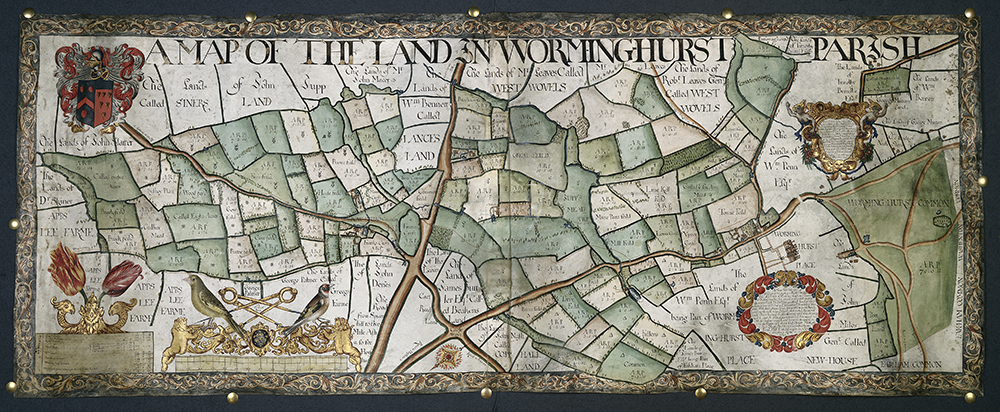
Record: Map of the Lands in Worminghurst (sic) Parish by Francis Hill, 1707
WSRO reference Add. Mss. 2155;original at British Library, Add.Ms.37420
In September 1676 Penn bought Warminghurst Place from Henry Bigland for £4,450, a mansion in the parish of the same name, located between Thakeham and Ashington. It was here between 1680 and 1682 that William worked on the Frame of Government for Pennsylvania, which later became the basis for the colony’s Constitution and influenced the American Declaration of Independence less than a century later.
Why did he choose this area? Firstly his wife Guliema Maria wished to move from their cold, damp home at Rickmansworth, where three of their infant children had died. Earlier visits familiarised him with the beauty of the countryside here and the location enabled easy access to the family lands in the Shoreham area and in East Sussex and Kent.
Secondly, it was a reasonably safe distance from London at a time when all nonconformists, and particularly their leaders, were under threat of arrest. The house was also remote within West Sussex being over 10 miles from any town. Yet London was still an important centre of Quaker activity, central Government and Court where Penn still had some influence and he needed to be no more than a day’s ride away. Finally Friends were active locally, particularly in the areas around Horsham, Billingshurst and Steyning.
It appears to be an early 1600s red brick mansion and has a view of the Downs to the south. William describes the house in a letter to his second wife Hannah Callowhill: “Warminghurst is a pleasant place, but more by nature than art [situation better than architecture or design]. The house is very large, but ugly, and yet has convenience, room enough for 12 or 20 people, more than our or your family, but greatness is the least of my thought…. For the chimneys, it is the worst part of the character, yet….it may serve” [i].
[i] The Papers of William Penn volume three 1685-1700 ibid p.432
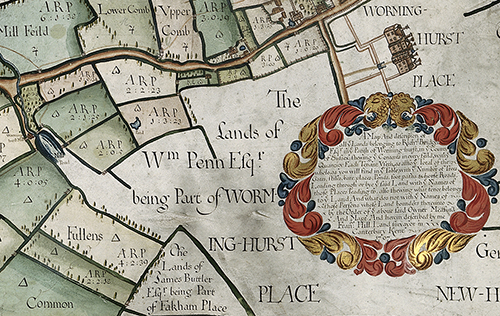
His principal family home for over 30 years, most of Penn’s significant family events happened here. Four of Penn’s eight children and two grandchildren were born here, and his wife Gulielma Maria may have died here as did her mother Mary Penington (nee Springett). In early 1696 he took his ailing eldest son Springett on carriage rides in the area, in an unsuccessful attempt to cure of him an illness, probably tuberculosis.
The 360 estate was situated on an elevated table of land with a superb view of the Downs to the south. It comprised a park, 3 houses, 2 cottages, 2 barns, 2 lofts, a water mill, a dove house, 4 gardens, 4 orchards, 20 acres of ploughland, 80 of meadow, 200 of pasture, 40 of woods, 20 acres covered with water, (including a lake to the south & a mill pond) rights of pasture on a common and, perhaps the ultimate irony, the advowson of the rectory of Warminghurst, that is, the right to appoint the local Church of England vicar!!
Inside the family owned at least 146 items of silver plate, including cutlery, plates, dishes, cups, trays, candlesticks etc[i] Some was inherited, some bought; and it was kept partly as an investment & partly to demonstrate status – Penn certainly bought new pieces in the 1670’s. His steward, Philip Ford’s accounts in the 1670’s reveal the wide range of food, clothes and household goods bought – they included luxury goods, food stuffs such as oysters, salmon, sturgeon, anchovies, venison, (the Parham estate was a provider) partridges, larks, gooseberries, Strawberries, cherries, asparagus, artichokes & saffron. Suppliers in West Sussex provided much of these. Also listed is clothing such as shoes, scarves, silk stockings, books for Penn and toys for the children. Between 1672 & 1674 he bought 3 coaches[ii].
What was the routine at Warminghurst? Several servants were employed. Life was regulated: the household rose at 5am in summer, 7am in winter and 6am in spring and autumn. They began each day by assembling to wait upon the Lord then took breakfast at about 9am. Household chores were attended to before Bible reading or martyrology at 11am and dinner at noon. Work was continued in the afternoon, at 6pm come more Bible reading or similar and at 7pm supper. After supper each servant reported on the day to master or mistress on the day’s work and took instructions for the next day. All gates & doors had to be bolted, fires & candles put out and everyone in bed by 10pm. The household were not allowed to swear, insult or gossip about each other, lie, lose one’s temper, blaspheme, flatter, be idle or get drunk, among other things! All quarrels had to be resolved before bedtime, i.e. anger was not allowed to fester overnight.
More difficult to achieve was the forbidding of “loud discourse or any troublesome noise”, given that William & Guli bought the 7 month old Springett with them when they moved in September. Some of the Penn family’s most important events happened at Warminghurst. Four more children were born to them here over the next 9 years: Letitia in 1678, William in 1680, an unnamed daughter in March 1683 who died here soon afterwards, and Guliema Maria in 1685 who was also to die here aged 4. Guli’s mother Mary Pennington was a frequent visitor and her life ended here in September 1682 during Penn’s 1st trip to America. Two grandchildren were also born here later.
The house saw visits by many prominent Quakers such as George Fox the founder, John Burnyeat, George Keith, Isaac Penington and Robert Barclay. Secret illegal Quaker meetings, both for worship and for administrative purposes, were held here and some of the former were large open-air gatherings (see the 1685 record below).
Many of Penn’s most important publications were researched and sometimes dated from Warminghurst. These included ‘A New England Firebrand Quenched’ in 1677 with George Fox and John Burnyeat, ‘To The Children Of Light Of This Generation’ in 1678, ‘Some Account Of The Province of Pennsylvania in America’ (a kind of promotional pamphlet) in 1681, and most importantly ‘The Frame of The Government Of The Province Of Pennsylvania’ in 1682.
When Penn left for the first time for the New World departure in September 1682, he did so from Warmingurst. Guli and the children, Springett (6), Letitia (4) and William (2), did not accompany him as she was newly pregnant and the children were very young. Even more significantly Guli’s mother Mary was seriously ill and was to die a couple of weeks after he left. Fully aware of the risks of such voyages, before his, William composed some moving letters[iii] read to the children by their mother at Warminghurst:
…..My dear Wife and Children,
My love, that sea nor land, nor death itself can extinguish or lessen toward you, most endearly visits you with eternal embraces, and will abide with you for ever: and may the god of my life watch over you, and bles(s) you and do you good in this world and for ever…..
…..1st Let the fear of the lord, and a Zeal and love to his Glory, dwell…..
…..2nd Be diligent in meetings of worship and busin(e)ss: stir up thy…..
…..3rd Cast up thy income, and save what it amounts to by wch thou may’st be sure to have it in sight and power to keep within compass, and I beseech thee to live low and sparingly, till my debts are paid…..I chuse not they should be marry’d into earthly covetous Kindred, and of Citys and towns of concourse beware,…..a country life and estate I like best for my children. I prefer a decent mansion of an hundred pounds per Annum, before ten thousand pounds in London,…..
…..Mr Dear Springett
Be good, learn to fear god, avoide evil, love thy book, be Kind to thy Brother & Sister & god will bless thee & I will exceedingly love thee, farewell Dear child,…..
…..Dear Letitia
I dearly love thee, & would have thee sober, learn thy book & love thy brothers. I will send thee a pretty Book to learn in, the Lord bless thee & make a good woman of thee, farewell……
…..Dear Bille
I love thee much, therefore be sober & quiet, & learn his book. I will send him one, so the lord bless thee, Amen…..
[i] The Papers of William Penn volume two 1680-1684 ibid p.187
[ii] The Papers of William Penn volume one 1644-1679 ibid p.576
[iii] The Papers of William Penn volume two 1680-1684 ibid pp.269-281
After nearly 2 years spent establishing the new colony, Penn returned on the ‘Endeavour’ to defend his colony against attacks by Lord Baltimore. He arrived at the Sussex coast on 6th October 1684 at ‘Worden (sic)…being within 7 miles of my own house’ and ‘I found my dear wife and family well to my rejoicing’[i]. Worden is most likely the hamlet of Worthing, now a seaside town of over 110,000.
Sadly, coinciding with well documented financial and political difficulties, William was to endure two personal tragedies at Warminghurst in the following years. His 4 year old daughter Guliema Maria died there in November 1689 and he was to lose his eldest son, 20 year old Springett.
[i] The Papers of William Penn volume two ibid p.604 & volume three p.341
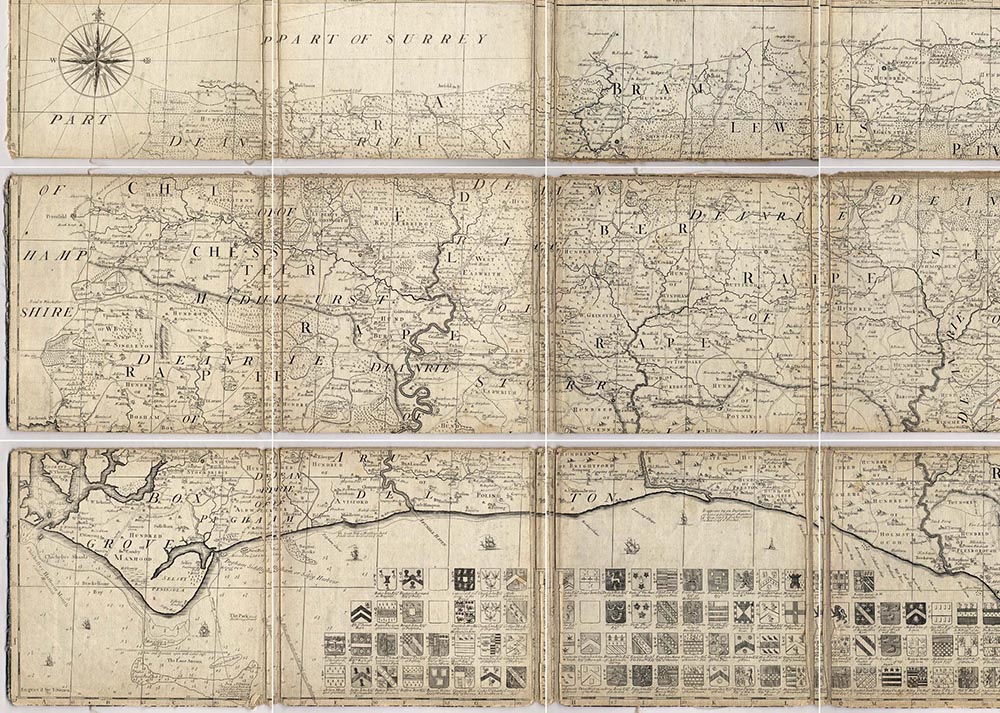
Record: Richard Budgen’s Sussex map 1724
WSRO ref. PM 47
Springett contracted a chest infection in February 1696 a condition which worsened through March and April. His father nursed & comforted him, taking him on long carriage rides in the countryside between Warminghurst and Lewes, where they owned property inherited from his mother. On 10th April he died.
His wife Guliema’s had already died at Hoddesden in Hertfordshire in 1694
Though Penn moved home in 1696, he regularly visited his children William junior (Billy) and Letitia, and grandchildren who lived here until it was sold in 1707.
Some information about sale of the house and the location of the site, relative to modern buildings, is given in these records at West Sussex Record Office:
Record: Papers, including site plans, about the site of Penn’s home at Warminghurst (George Dudley Seymour collection)
WSRO reference Add. Mss. 48,105 & Add.Mss. 48,106
Extract from papers in Add. Mss. 48106:
The black lines are a tracing of the modern ordnance survey map made to the same scale as the 1707 map of Warminghurst. The red lines coincide with what appears on the 1707 map if this tracing is laid over it…..
It is clear evidence that the site of the Apsley Penn house was that of the buildings now existing at Warminghurst.
[written in ink, not signed nor dated]
Warminghurst was sold in 1644 by Haslerige and Williamson and their wives to Henry Bigland of Gray’s Inn [London] who sold it in 1676 to William Penn. In Penn’sButler who pulled down the tudor [sic] house and built an entirely new one. The property remained in the Butler family till 1789 when it was allotted to Anne Jemina, eldest daughter of James Butler, wife of Robert Clough, by whom they were sold in 1805, to Charles Duke of Norfolk, who in turn pulled down the house built by James Butler, and nothing now remains on the site, though the location is plainly evident.
Henry A. Wright
95 Ingersoll Grove
Springfield
Massachusetts
[typewritten on headed paper, undated]