Penn the persecuted
Record: Assize Court at East Grinstead 20th March 1682
WSRO ref. Add.MS. 37,103 no.8

Transcript: Charles the Second, by the grace of God, king of England, Scotland, France and Ireland, defender of the faith etc., to our sheriff of Sussex, greeting. We order you that you do not fail in any part of your jurisdiction to cause to appear before our justices at Assizes, wisely assigned, in your county William Penn, lately of Worminghurst in your county, esquire, at the next assizes to be held in your county, to answer to us for certain transgressions and offences against the form of the statutes issued for the discovering and repression of Popish recusants, for which he should appear before the aforesaid justices, for which you have this writ. Witness John Charlton, knight, at East Grinstead 20 March, 34th year of our reign.
Endorsed: The within named William Penn has nothing within my jurisdiction that could be seized, nor can he be found here.
Henry Goring
Translated from the Latin by Alison McCann
Record: Sussex Archaeological Collections volume 134 (SAS, 1996)
(WSRO ref. Lib 13390)
In this volume Timothy J. McCann’s article ‘Soe farr from thee as east from west: William Penn’s prosecution as a popish recusant in 1682’ pp.235-237 has further analysis and detail on this writ.
Anti-Catholic legislation had been used as early as 1559 and was strengthened by various later statutes, particularly James I’s Act for the Better Discovering and Repressing of Popish Recusants of 1605. Catholics who did not worship in established churches were required to swear an oath of allegiance to the Crown and Quakers were entrapped by their fundamental doctrine of refusal to swear oaths.
As early as 1677 Penn was being harassed by Sir Henry Goring of Highden and John Alfold of Offington, Commissioners for Recusants in Sussex[i]. He, and other Friends, had appealed to Parliament asking for toleration and ’affirming’ their loyalty to the crown but were caught up in the anti-Catholic hysteria whipped up by Titus Oates in 1678-81. William and 17 other Quakers living near Warminghurst are listed in a Treasury Office Entry Book, dated 7th March 1679, as “…several persons called Quakers that are prosecuted as Popish Recusants but in reality [are] true Protestants.” [ii]. The full list appears below:
Richard Scrase, gent., of Hurstpierrpoint; Walter Scrase of Blatchington, Richard Haiter, yeoman, Jno. Martin, tailor, William Parker, yeoman all of Steyning; John Carter, husbandman, Edward Blackeston, maltster, Jacob Knowles, joiner of Wiston; Thomas Snashall of Burlock; blacksmith, Robert Thorndon, shoemaker, James Lexford, husbandman, of Cowfold; William Penne of Warminghurst, Esq.; Nicho. Beard, senr., of Hamer, yeoman; Humfrey Killingworth of Bolney; Thomas Parson of Storfam [Stopham], Robert Alder, husbandman, William Eason, smith, Thomas Parson, yeoman, of Cowfold.
In Penn lobbied the second Whig Parliament from October 1680 submitting papers and publishing at least four tracts complaining about their treatment as Catholic recusants[iii]. In March 1681 he and 19 other Friends were charged with being Catholics and Penn was cleared by the Lords of the Treasury on 30th April 1681, ordering:
Treasury warrant to the Treasurer’s Remembrancer, the Clerk of the Pipe, and the Comptroller of the Pipe, to stay all further process against William Penn, of Worminghurst Place, co. Sussex, for 20l. supposed to be by him forfeited for one month as a Popish Recusant upon the Act of 28 Eliz., the Treasury Lords being very well satisfied that said Penn is not or ever was a Popish Recusant. The sheriff of said county is to be hereby given a discharge for said sum on his accounts.[iv]
By late summer 1681 Titus Oates’ falsified claims of a Catholic assassination plot against King Charles II were discredited and there was a period of relative calm for non-conformists although local harassment continued as the record below demonstrates.
[i] The Papers of William Penn volume one 1644-1679 ibid p.516-517
[ii] Calendar of Treasury Books, Volume 5, 1676-1679 (HMSO, 1911); also British History Online
[iii] The Papers of William Penn volume two 1680-1684 ibid p. 50
[iv] Calendar of Treasury Books, Volume 7, 1681-1685 (HMSO, 1911) Warrants not Relating to Money VIII, p. 331; also on British History Online
1685 Another Warrant for His Arrest
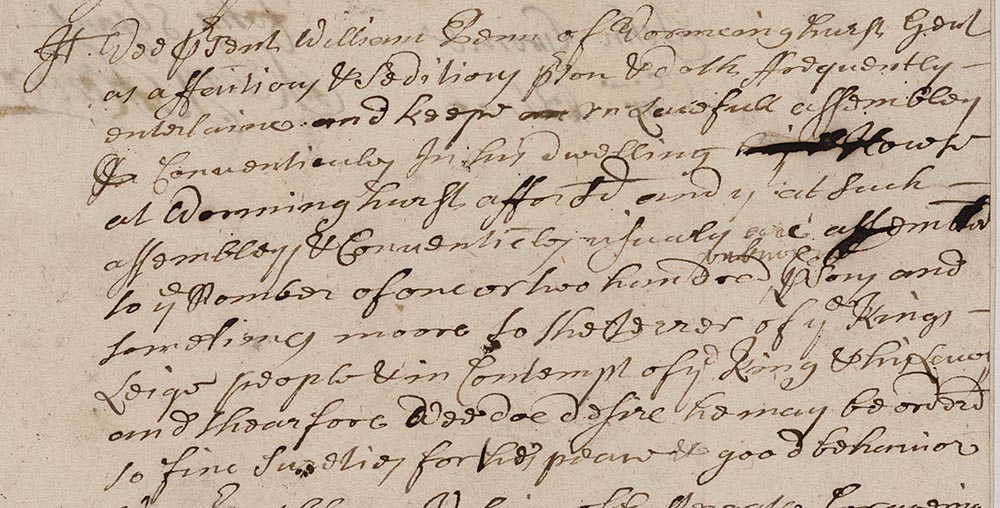
Record: Court of Quarter Sessions at Arundel 13th/14th January 1685 extract
WSRO ref. QR/W173,M.31
At Arundel on 12th January [check] 1684/5 the Court of Quarter Sessions ordered his arrest “as a factious & seditious person (who) ….doth frequently entertain and keep unlawful assembly & conventicles in his dwelling house …. usually…. assembled to ye number of one or two hundred …. and sometimes more to the terror of ye King’s Liege people and in contempt of ye King and his laws….”
The arrival of William & Mary from the Continent signalled a resumption of persecution of nonconformists. Indeed with his influence at Court ended by James II’s flight, arrest warrants for high treason were issued against Penn and he spent much of the late 1680’s and early 1690’s in hiding. In September 1691 he sailed from Shoreham to temporary exile in France. Although travelling a good deal, William was still able to spend periods at his isolated West Sussex home.
Despite these warrants, perhaps partly because of the status of his father & his contacts at Court, he never seems to have been actually arrested or imprisoned in Sussex. Certainly the authorities here were never as energetic or vindictive as those in many other counties.