Cecil Bisshopp and the War of 1812
Parham 2/3/2/20
View finding aid
A rich source of insight into the events of Cecil’s time in Upper Canada during the War of 1812 is to be found in this set of correspondence and papers. They include letters both to and from Cecil, largely from colleagues in the military, and bear witness to the duties which engaged him from day to day as well as the practicalities of running the British military effort to protect the borders of Upper Canada (Ontario) from American invasion.
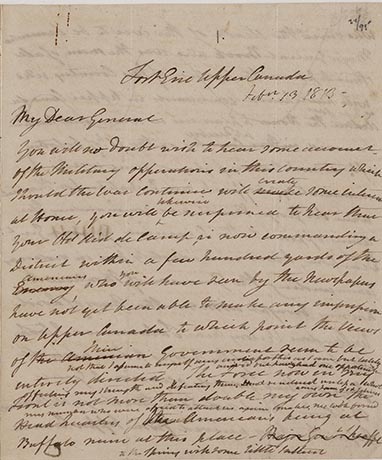
‘I arrived at Quebec on the 18th of October, after a most tedious passage of nine weeks…‘
Cecil recounts arriving first in Quebec, on 18th October 1812 ‘after a most tedious passage of nine weeks.’ (Parham 2/3/2/20/95). He then departs immediately for Montreal, where he is placed in command of the garrison there.
The Battle of Queenston Heights had taken place on 13th October, and was the first major battle of the War of 1812. It ultimately resulted in victory for the British (Cecil Bisshop calls it ‘another proud day for the British Arms’ despite the unquestionable blow of the loss of the esteemed General Isaac Brock, who had successfully commanded forces in Upper Canada for a number of years, and who had been responsible for vital fortification of Canadian defences in advance of the war.
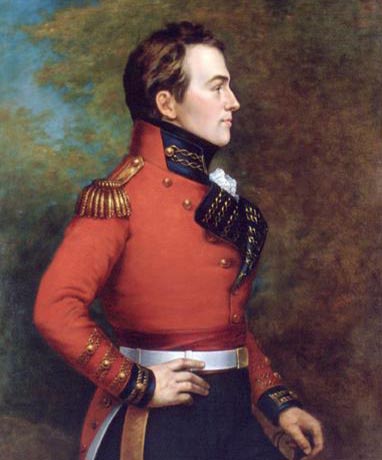
It was at this point that Cecil Bisshop was instructed to move on to Upper Canada, under the command of General Sir Roger Hale Sheaffe, who had now taken on Brock’s role as Lieutenant Governor of Upper Canada. He arrived at Fort George, close to where the Niagara River met Lake Ontario and recorded:
On my arrival my commission being that of an Inspecting Field officer of the Militia, I was ordered to inspect the different Militia Corps on the Line and to make my report as to their fitness for Service…
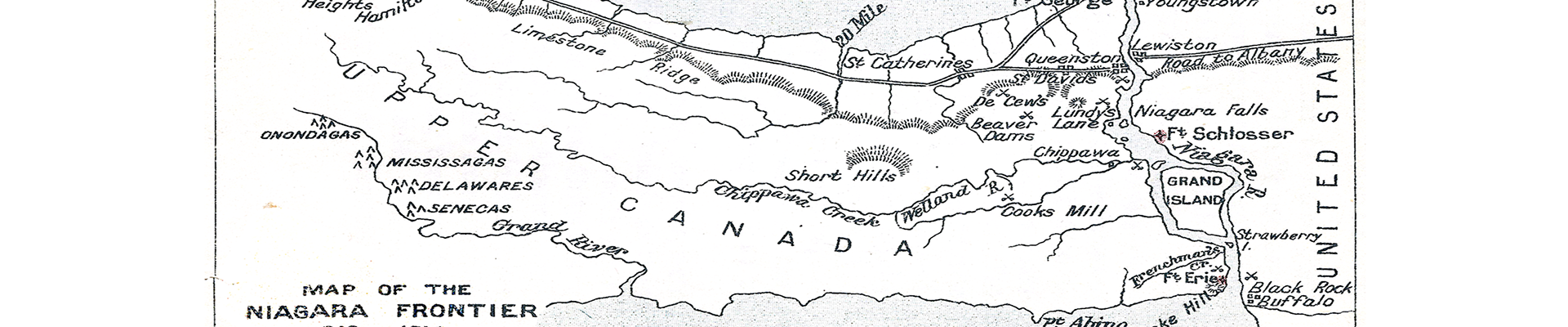
Cecil was sent on to take command of the troops at Chippawa just above Niagara Falls, describing it as ‘the Post of Honor’. Here he had responsibility for around 1200 men – consisting of Regular troops, Militia and First Nations warriors.
Prior to Canadian Confederation in 1867, the defence of Canada was conducted by British Army regiments and units of Militia (non-professional soldiers). This situation came with a multitude of issues, many of which are a recurring theme in Cecil Bisshopp’s correspondence. The shortcomings of the militia are complained of, with desertion being a particular problem:
The continued desertions of the Militia render the Regular Troops the only efficient force I have to depend on, in case of a sudden attack
The shortage of numbers and at times ‘a total want of Subordination’ (Parham 2/3/2/20/16) constantly hinder the British war effort.
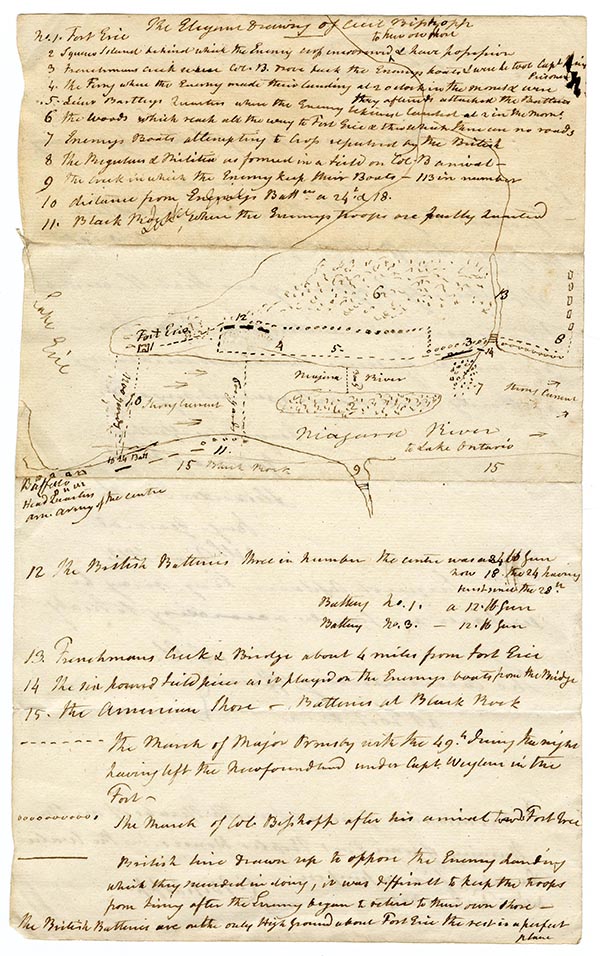
One of the most notable events in which Cecil Bisshopp was involved was the Battle of Frenchman’s Creek, on 28th November 1812. American forces under the command of Brigadier General Alexander Brig Smyth (or Smith) launched a two-fold attack aimed at the British post at Fort Erie, enabling them to cross over the Niagara River from New York State into Upper Canada. One party were dispatched to disable the cannons, or batteries, at the Red House near Fort Erie by ‘spiking’ them; the others to destroy the bridge over Frenchman’s Creek between Fort Erie and Chippawa, where Cecil Bisshopp and the various troops under his command were based, thus preventing reinforcements from reaching the fort when the American troops invaded. Although the American mission to sabotage the cannons was achieved, the British ultimately succeeded in thwarting the attack, and Cecil Bisshopp distinguished himself. Bisshopp’s letters include a detailed account of the events of the battle, lists of the men of each regiment wounded, killed, or taken prisoner, and a hand-drawn map (see opposite) illustrates the movements and manoeuvres of the troops involved. Many letters in the aftermath deal with matters such as the protocols for exchanging prisoners
and arrangements for the deployment of the limited number of medical personnel to tend to the injured.
The winter of 1812-1813 was a quieter period, with the Americans retreating to winter quarters. Nonetheless Bisshopp’s correspondence during this time is prolific, much of it relating to disciplinary issues amongst the troops. Apart from the problem of desertion, there are references to drunkenness, theft, ‘abusive language’ and incidents of violence. The trial of offenders by Court Martial is discussed in a number of instances where the punishment for those found guilty can be flogging (some letters debate the maximum number of lashes permitted) and in at least one case referenced here, death by firing squad. Patrick Murphy was shot yesterday (Parham 2/3/2/20/88). Another officer comments; Poor Murphy died yesterday, he displayed much fortitude and was full of repentance, the business being so well arranged, he did not suffer an instant… (Parham 2/3/2/20/89). The crime ‘Poor Murphy’ had committed to merit such a penalty is never directly reported.
The correspondence suggests Bisshopp himself had no enthusiasm for violent punishment. In one letter of December 12th 1812, he responds to a court martial verdict referring to the law that such a court has not the power to inflict more than 300 lashes. I do not see how any officer can order a Soldier to receive a greater number… adding Even had I the power which you mention of a year & a day before it is put into execution I am the very last that would avail myself of it… Bisshopp order the court to revise their verdict. In a number of other instances, there is evidence of Bisshopp asking for prisoners to be forgiven and their punishments set aside.
Lt Col. Bisshopp approves of the Sentence of the Court Martial on Gunner William Harrison, but in consequence of his very good general Character Lt. Col. Bisshopp hopes he will be aware of the enormity of his crime & remits the punishment awarded…
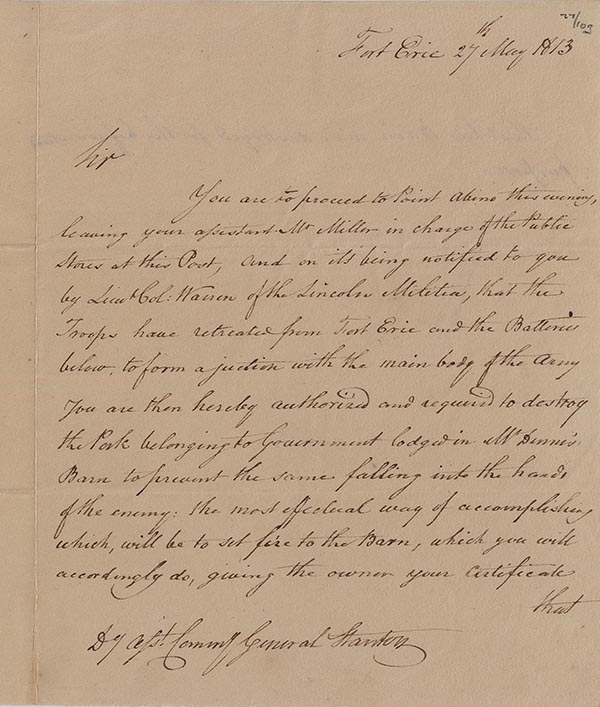
As winter 1813 turns to Spring, the military letters become more intermittent in number – whether fewer were written, or that fewer have survived is unknown. Of the events in which Bisshopp was involved, the fullest accounts are provided in his letters to his family back in England (see Bisshopp family correspondence). As Bisshopp writes to his father, ‘having been left entirely to ourselves the whole Winter‘, the American troops step up their offensive on the Niagara frontier. On 27th May, the Americans succeed in landing at Fort George on the Canadian side of the Niagara River, about 30 miles from Bisshopp’s base at Fort Erie. Outnumbered, Brigadier General John Vincent, commanding the troops at Fort George, makes the decision to retreat and make an escape. Cecil Bisshopp likewise receives orders to evacuate Fort Erie and join his troops with those from Fort George – it is assumed he is amongst the British troops subsequently gathered at a camp in Burlington Heights. A letter written from Fort Erie on 27th May (the correspondents concerned are unclear) contains orders to burn a barn full of pork to prevent the same falling into the hands of the enemy (Parham 2/3/2/20/103).
On 5th June 1813, the British troops advanced to Stoney Creek under cover of night and launched an attack on an American encampment there, resulting in the capture of Brigadier-General John Chandler and Brigadier General William H. Winder – the two American commanding officers. Although he describes the events in his letters back home, Cecil Bisshopp was in command of the reserve, and so his troops were not, it seems, directly involved in that conflict.
Indeed he writes to his mother,
…unknown to me, who am second in command, a most desperate expedition was undertaken to attack them by the very troops that were in Fort George under Lt. Col. Harvey the deputy A. General, which wonderful as it may appear succeeded in repelling the Enemy…Parham 2/3/2/5/65
It is unclear at what point Cecil arrives at Stoney Creek, but for ‘a most anxious moment’ he describes being placed in command of the troops in the aftermath of the attack, due to General John Vincent being missing ‘having lost his way in the woods’ (he appears to have been injured falling from his horse). Cecil marvels at the effect of the attack, where, despite the Americans’ superiority in numbers (anoth
er frequent refrain in his letters), they respond by retreating:
We were going to retreat with our small Force when strange to relate the Enemy began retreating first, & have ever since been in such consternation that they do not trust themselves out of Fort George after dark…
The Americans consolidated all of their troops on the Canadian side back at Fort George. Fort Erie, only recently taken by the Americans, was abandoned by them on 9th June. The British set up various outposts close to Fort George from which to both defend against American raids and harass Americans outside the confines of Fort George. One of these was at the DeCew (or DeCou) House in Thorold township occupied by a garrison led by Lieutenant James FitzGibbon. The American forces at Fort George planned an attack on DeCew, and despatched troops under the command of Lieutenant-Colonel Charles Bœrstler. FitzGibbon however, was forewarned, both by First Nations scouts who were monitoring the movements of the Americans and, famously, by a Canadian woman named Laura Secord who became aware of the planned attack, and set out by foot to warn FitzGibbon, walking around 20 miles through wild terrain to reach the DeCew House.
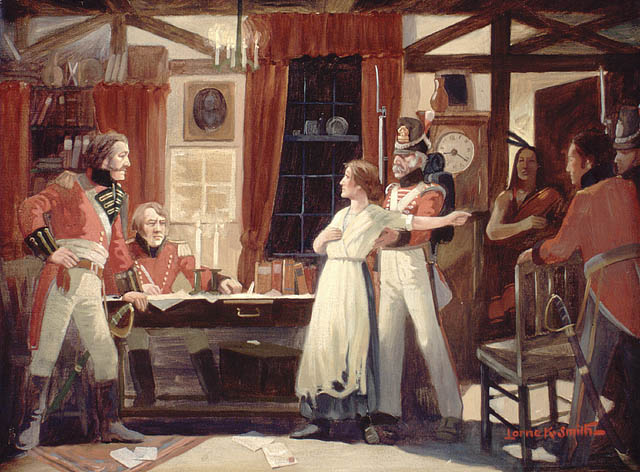
The ensuing Battle of Beaver Dams on 24th June was a victory won by First Nations warriors, primarily Kahnawake (or Caughnawaga), and Mohawk warriors, who ambushed Bœrstler’s forces with FitzGibbon and his troops following afterwards, at which point Bœrstler surrendered . In a letter written to Brigadier-General Vincent on that day, Cecil Bisshopp has arrived at Beaver Dam in time to sign the capitulation entered into with Bœrstler, and his troops take a number of the Americans as prisoners of war, a matter in which he allow himself to take some pride,
whilst acknowledging that the First Nations warriors, …were the principal performers in this affair, but as the disposition of the troops and all arrangements were made by me I must give myself some little credit.
His previous connection with Bœrstler, who commanded at the American base at Black Rock during Cecil’s time at Fort Erie is an additional source of satisfaction for Cecil:
The Commanding Officer of this party is the Person, who all Winter has been commanding opposite to me at Fort Erie, and I can not but mention what pleaure it gave me, when I found, he was [the] person I had captured…
With the decisive triumphs at Stoney Creek and Beaver Dams, and the rumoured arrival of ‘thousands’ of First Nations’ warrior to aid their cause, it seems to Cecil that the end of his particular mission is imminent;
…in which case we shall certainly retake Fort George in a Few days – when I shall apply to be removed to Kingston, from whence I shall take the first opportunity, of asking leave to return Home again to England…