The Sussex Declaration
Background
In 2015 professor and political philosopher, Danielle Allen, established the Declaration Resources Project at Harvard University. The purpose of this project was to identify previously unknown copies of the American Declaration of Independence and to use new developments in technology and archival practice to answer questions about the text, the signatories, and how news of the Declaration spread around the newly formed United States and the world.
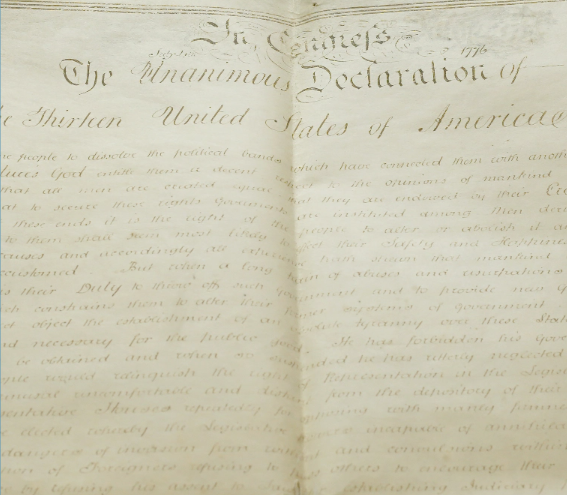
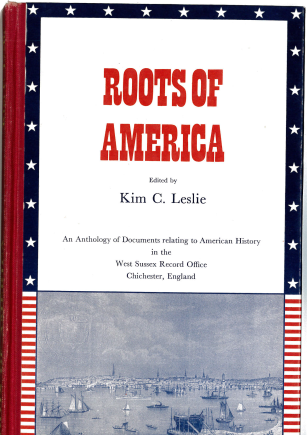
In the course of research for this project Danielle Allen and her colleague Emily Sneff, Declaration Resources Project Manager, identified a promising entry from West Sussex Record Office (WSRO) on The National Archives’ online catalogue. Add Mss 8981 was described as a manuscript copy, on parchment, of the Declaration in Congress of the thirteen United States of America, 4 July 1776 and was tentatively dated to the late 18th century. It had been deposited at WSRO in 1956, catalogued shortly thereafter, and publicised in a Record Office publication, Roots of America, edited by Kim C. Leslie the Education Officer at WSRO, in 1976. However, the description of the document, which did not include the word ‘independence’, meant that its significance had remained undetected.
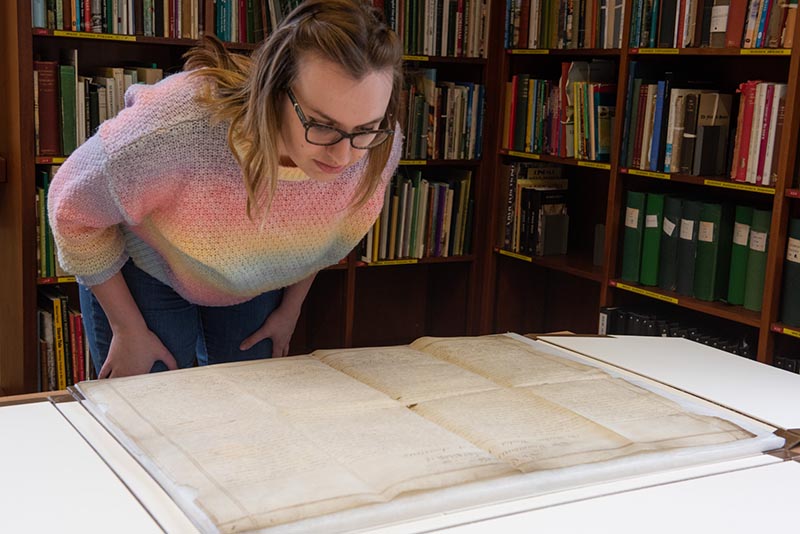
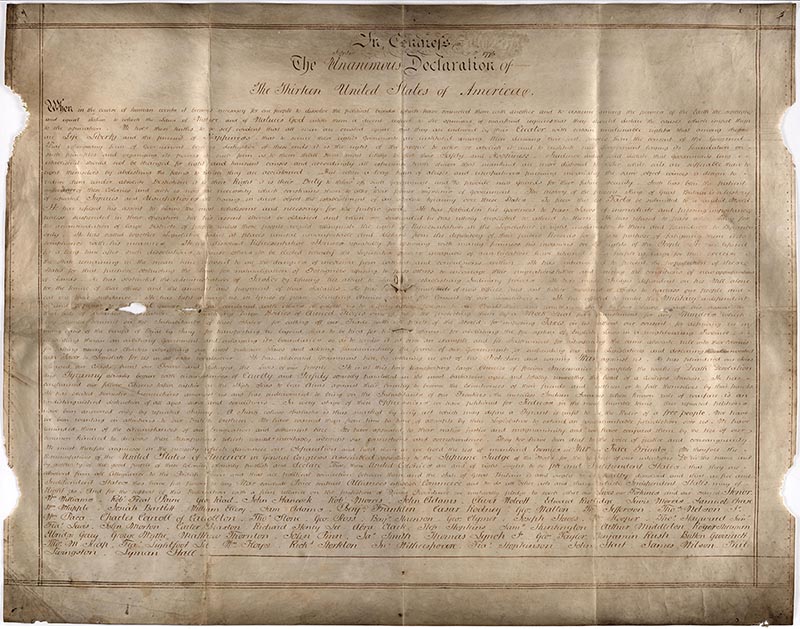
This changed when Allen and Sneff visited West Sussex Record Office in 2016 to view the document, which would subsequently become known as the Sussex Declaration. They recognised that this was an extremely rare large format parchment manuscript copy of the Declaration of Independence and could date to the 1780s, the period of political contestation leading up to the Constitutional Convention. It was an incredibly significant discovery.
The Document
View the virtual exhibit of The Sussex Declaration
At 24” x 30” (60.9 cm x 76.2 cm) the Sussex Declaration is on the same ornamental scale as the Matlack Declaration housed in the American National Archives in Washington DC, the only other known ceremonial parchment manuscript copy of the document. Although the size is the same, there are some key differences. The orientation of the two documents differs; the Matlack Declaration is in portrait format whilst the Sussex Declaration is landscape. The Matlack Declaration was signed by the delegates to Continental Congress, whereas the Sussex Declaration lists the signers written in the hand of a single clerk. Allen and Sneff also noted that the list of the names of the signers is not in state order, as was typical of other copies of the Declaration; the names are scrambled and several are even misspelled.
There were a number of other intriguing features of the document which it was felt would bear further investigation, including a scraped area to the right of the document’s title, which suggested the erasure of an error, and holes in the corners of the parchment, which may have been caused by pins or nails. There were also areas of loss on the two shorter sides of the document which could have been the result of a seal or clasp or of rodent damage.
Scientific Testing
In order to facilitate further research, a partnership project was set up in 2017 between Harvard University, the Library of Congress, the British Library and West Sussex Record Office which enabled scientific tests to be carried out. Conservation scientists at the British Library, Library of Congress, and the University of York conducted non-invasive analyses of the parchment including multi-spectral imaging, X-ray fluorescence (XRF) capture, and protein analysis.
The imaging revealed a date beneath a scraped erasure to the right of the document’s title. Underneath the scraping, researchers found a partially inscribed date, reading either ‘July 4, 178’ or ‘July 4, 179’.
The erased date was written along a slight downward slant, indicating that the clerk made two errors when originally writing the date. They wrote the wrong date initially, presumably using the year of production rather than the year in which the Declaration was enacted, and also failed to maintain a horizontal line. Imaging revealed that the inked lines establishing horizontal margins for the parchment, and the lining of the parchment used by the clerk to keep the rest of the text properly aligned, were added after this failed inscription was scraped off the parchment, presumably to avoid further errors.
The document is written in iron gall ink which was typically made from crushed oak-galls (a type of growth on trees caused by parasitic wasps), a solvent, such as wine or vinegar, and copperas (ferrous sulphate produced by roasting iron pyrites). There can be a great degree of variation in iron gall inks due the number of variables involved in its production but the ink used in the Sussex Declaration was determined to be of similar chemical composition throughout. This indicates that the initial titling, the corrected titling, the body of the text, the list of signatories, and the corrections within the body of the text were written in a relatively short window of time.
These discoveries support the date of the 1780s for the Sussex Declaration proposed by Allen and Sneff in their paper, ‘The Sussex Declaration: Dating the Parchment Manuscript of the Declaration of Independence Held at the West Sussex Record Office (Chichester, UK)’, The Papers of the Bibliographical Society of America, vol. 12, no. 3 (September 2018). The findings also support their hypothesis that the clerk was inexperienced.
In addition, through X-ray fluorescence analysis, the researchers discovered high iron content in holes in the corner of the parchment, providing supporting evidence for the use of iron nails to hang the parchment at some point. The suggests that the Sussex Declaration was prepared for visual display, not merely for reading. The protein analysis revealed that the parchment was prepared from sheepskin, rather than more expensive calfskin. The parchment is American and is most likely to have been produced in New York or Philadelphia.
Provenance
One of the key questions this research prompted, and one which is still under investigation, is how this rare copy of the Declaration of Independence came to be in Chichester. The source of the deposit may provide a clue. The Sussex Declaration was deposited at WSRO in 1956 by Leslie Holden, an employee of Rapers. Now operating as Stone Milward Rapers, or SMR, Rapers is the oldest firm of solicitors in Chichester, dating back to 1730. The Sussex Declaration was deposited at WSRO with a collection of other documents including some associated with the Dukes of Richmond, long term clients of Rapers whose family seat at Goodwood lies just outside Chichester.
Charles Lennox, 3rd Duke of Richmond (1735-1806) had a keen interest in American affairs and was known as the ‘Radical Duke’ for his support of the colonists during the American Revolutionary War (see The Radical Duke: the 3rd Duke of Richmond and the American Revolutionary War). It seems possible that the Sussex Declaration was originally held by the ‘Radical Duke’ and was sent to Rapers solicitors (along with other papers from the Dukes of Richmond) for safekeeping, either by the 3rd Duke himself or by the 5th Duke, who sought to recover the missing political papers of the 3rd Duke.
Further work by Allen and Sneff suggests that the Sussex Declaration was commissioned by James Wilson, one of the signatories of both the Declaration of Independence and the Constitution (see ‘Golden Letters: James Wilson, the Declaration of Independence, and the Sussex Declaration’, Georgetown Journal of Law and Public Policy, vol. 17, no. 1 (Winter 2019)) and it is hoped that additional research may shed light on the journey of the Sussex Declaration from the United States to Chichester.
For further information about the Declaration Resources Project and Allen and Sneff’s work on the Sussex Declaration, please see the Declaration Resources Project (harvard.edu) website.