The Radical Duke: the 3rd Duke of Richmond and the American Revolutionary War
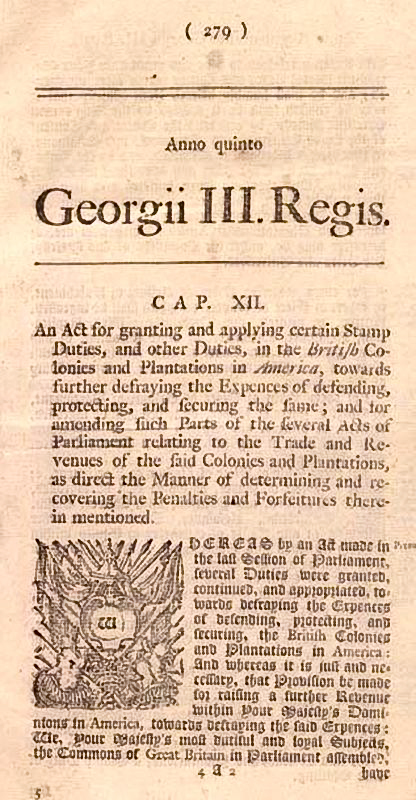
In 1765 the British government passed the Stamp Act which imposed taxes on the British colonies in North America. It required that printed materials, such as legal documents, newspapers, and even items such as playing cards, be produced on stamped paper made in London. It was a deeply unpopular act and prompted protests from the American colonists who objected to being taxed by the British government when they were not represented in Parliament. Their rallying cry was ‘No taxation without representation’.
Under pressure, Parliament repealed the Stamp Act in 1766 but at the same time passed another act, known as the Declaratory Act. The act stated that Parliament:
had hath, and of right ought to have, full power and authority to make laws and statutes of sufficient force and validity to bind the colonies and people of America … in all cases whatsoever.
Effectively it gave Parliament the power to make laws and changes to the colonial government even though the American colonists were still not represented in Parliament.
Whilst the 3rd Duke of Richmond had supported the Declaratory Act when it was passed in 1766, as tensions rose between Britain and the American colonies in the 1770s he became an outspoken critic of it. In 1777 he wrote to Rockingham that:
I cannot feel easy till I have voted for a Repeal of the declaratory act…long ago my own feelings and the bad use that has been made of that act have convinced me that it is indefensible
(The Radical Duke: Charles Lennox Third Duke of Richmond, Olson, Alison Gilbert, p. 37)
His opposition to the Declaratory Act solidified into support for the idea of American independence, particularly after France entered the war in 1778. Richmond argued that Britain should give up the American colonies in order to focus its efforts against France, writing:
This Event [the Franco-American Treaty of Alliance of May 1778] makes it the more necessary to come out with the Proposition of declaring the Independency of America. This being done instantly, and publickly, declaring against a War with France notwithstanding this Treaty, is the only means to keep America from joining with France as allies. It is the only Chance we have for preventing such a Measure which must be our Ruin.
(The Radical Duke: Charles Lennox Third Duke of Richmond, Olson, Alison Gilbert, p. 37)
He initiated a debate in 1778 calling for the removal of British troops from America; whilst responding to this motion Pitt the Elder (at that point the Earl of Chatham) dramatically collapsed, dying a few weeks later.
Throughout the American Revolutionary War Richmond was a relentless critic of the government’s management of the war effort which made him few friends. The press, referring to his French ancestry, characterised him as a traitor whilst in 1781 his criticism of Lord Rawdon’s role in the execution of the South Carolina militia leader Isaac Hayne almost led to a duel. One Parliamentary colleague, Charles Jenkinson, described him as a ‘plagueing fellow’.
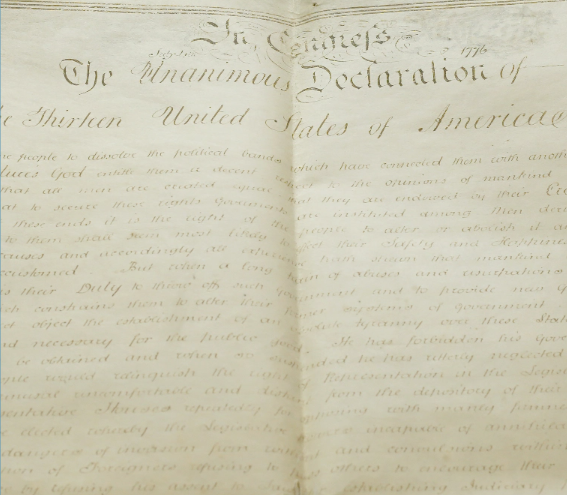
Richmond’s support for American independence, amongst other evidence, has suggested that he may have owned The Sussex Declaration at one point.
Later Career
Richmond went on to become a keen advocate for electoral reform, drawing up a bill providing for manhood suffrage, equal election districts, and annual parliaments. He served as Master-General of the Ordnance for 13 years, introducing a series of important reforms and starting a topographical survey of the south coast which would ultimately become the Ordnance Survey. However, by 1795 Richmond’s earlier support for reform had made him a liability to the government and he was replaced by Marquis Cornwallis. Richmond never held political office again. He died on 29th September 1806 and was buried in Chichester Cathedral.
The Lost papers of the 3rd Duke
The Goodwood Archive is held at West Sussex Record Office and includes papers and correspondence from many of the previous Dukes of Richmond. Regrettably, particularly given his controversial political career, very few of the 3rd Duke’s papers have survived. It was originally thought that his papers had perished in a fire at Richmond House, London, in 1791, but a contemporary account of the fire specifically mentions that they were all saved. The Duke’s will bequeathed all of his personal papers to his natural daughter, Henrietta Ann Le Clerc instructing her to ‘offer to any persons living at my decease to return to them all letters that such persons may have written to me’. He further desires that his executors deliver all such papers ‘over to her as soon as they conveniently can they themselves looking at them no more than may be necessary to make . . . Selection and not suffering any other person to examine or peruse them’. It is possible that Henrietta destroyed many of these papers, perhaps through too faithful compliance with her father’s injunction that no-one except the original authors should have the papers.