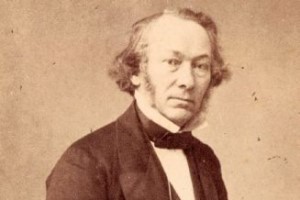
Richard Cobden
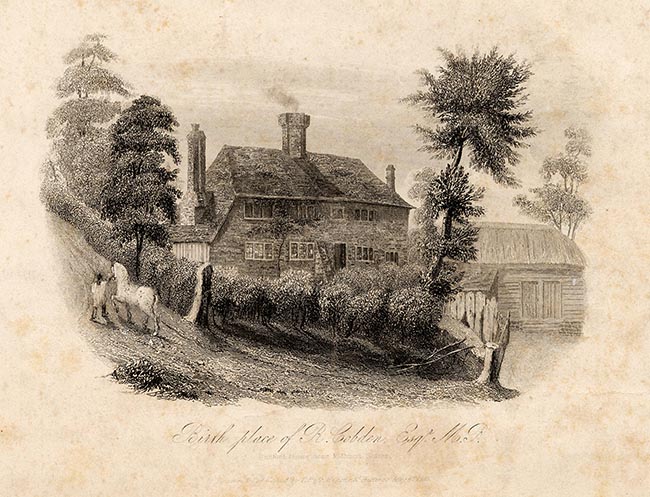
The roof which now shelters me is that under which I was born, and the room where I now sleep is the one in which I first drew breath. It is an old farm-house, which had for many years been turned into labourers’ cottages. With the aid of the whitewasher and carpenter, we have made a comfortable weather-proof retreat for summer; and we are surrounded with pleasant woods, and within a couple of miles of the summit of the South Down hills, where we have the finest air and some of the prettiest views in England.
Richard Cobden to Henry Ashworth, 7 October 1850
Richard Cobden (1804-1865), statesman, political campaigner and ‘Friend of America’ was born in 1804 in a small farmhouse at Dunford close to the village of Heyshott, near Midhurst in West Sussex, one of eleven children of William Cobden and Millicent Amber. His family’s roots in West Sussex could be traced back several hundred years, and although economic struggles cost Cobden’s father the Dunford farm when Cobden was aged just five, he retained a deep sense of connection and belonging with the place. After years spent both in London and in the north of England, Cobden purchased his family’s old property at Dunford which he rebuilt over the next few years. The Cobden family settled there permanently in 1853.
When Cobden’s family first left Dunford in 1809, they moved to another farm near Midhurst, where Richard and his brother Frederick attended the local school. In 1814, William Cobden was forced to sell this farm too, again through financial constraints and the family eventually relocated to West Meon in Hampshire where his mother opened a village shop.

Richard Cobden then spent many years away from Sussex, firstly at a Yorkshire boarding school which Cobden later compared to the notorious Dotheboys Hall in Charles Dickens’ novel, Nicholas Nickleby. After leaving the school in 1819, Richard began work as a clerk for his uncle, a Mr Cole, who was a merchant in London dealing in textiles. After some early difficulties, Cobden was promoted to travelling salesman for the firm and spent time touring the British Isles.
In 1828, Cobden moved to Manchester with two friends to set up in business selling printed calico. The business prospered and in 1831 Cobden and his partners set up their own factory. In the following years, Cobden continued to achieve success as a manufacturer and became settled in Manchester’s business community. Much of his spare time was spent, as it had been since leaving school, in extensive reading and attempts to ‘fill in the gaps’ in what he felt to be his inadequate education. In 1835 he began to contribute articles to the Manchester Times on current affairs and in the same year published his first pamphlet entitled ‘England, Ireland and America’, shortly prior to his first visit to the United States. These early writings raised themes which would occupy Cobden’s thinking and motivations for much of his career – free trade, non-interventionist foreign policy and the reduction of spending on armaments.
Cobden became increasingly involved in local affairs and politics during the 1830s, with a notable interest in education. His activities included helping to found the Manchester Athenaeum, becoming vice-president of the Manchester Literary Society and taking a leading role in the local Friends of Education. On the political side, Cobden served for a time as a police commissioner and was elected to the board of the Manchester Chamber of Commerce. He also became involved in campaigning for the incorporation of Manchester following the Municipal Corporations Act of 1835, during which he spent time in London and became acquainted with many leading radicals of the day. In October 1838, Cobden joined the newly established Anti-Corn Law Association, beginning his involvement in the eight-year campaign for repeal of the corn laws, which would dominate his time as well as bring Cobden himself to prominence on a national level.
Richard Cobden served as a member of Parliament almost continuously from 1841, when he was elected MP for Stockport, until his death in 1865. In the General Election of 1847, Cobden was elected in two constituencies – Stockport and the West Riding of Yorkshire, at that time one of the largest constituencies in the country. Cobden opted to serve the latter, and remained as MP for the West Riding for a decade until he lost his seat in the General Election of 1857. Two years later, he was elected MP for Rochdale. Cobden ran initially as a Radical, then as a Liberal from 1859 when that party was formally founded, absorbing the Whig and Radical factions in Parliament.
In the late 1840s and 1850s, Cobden became particularly known for his campaigning for peace and for his efforts to achieve a reduction in defence spending in Britain. He sat on parliamentary committees on army expenditure and official salaries and became associated with the Peace Society. He was also involved in the peace congresses which took place in Europe in the mid 19th century. At the Paris Peace Congress of 1849, Cobden was the most high-profile political leader in attendance and delivered his major address in French.
It was, however, a difficult era in which to argue the case for peace. In 1851, Louis-Napoleon Bonaparte (the President of France) launched a successful coup in order to remain in power, dissolving the National Assembly. This led to renewed fears in Britain of a French invasion and support for increased defence spending rather than the retrenchment pushed for by Cobden. The outbreak of the Crimean War in 1853 was a further blow to Cobden’s cause.
The later 1850s were a difficult time for Cobden, who experienced personal tragedy when his only son died in 1856, which also caused his wife Catherine to have a breakdown. After the loss of his seat in the General Election of 1857, Cobden retired from public life for two years. In 1859, Cobden took his second tour of the United States, spending four months travelling between New York, Washington and Chicago. Whilst he was away, he was elected MP for Rochdale.
When Cobden returned from the States, he turned down an offer from Prime Minister Lord Palmerston to join the cabinet as president of the Board of Trade due to their political differences. One of the triumphs of Cobden’s later career was his successful negotiation of a trade agreement with France, which became known as the Cobden-Chevalier treaty; this was signed in law in January of 1860.
The last years of Cobden’s life coincided with the years of the American Civil War and the topic dominated his correspondence and political activism during this time.