William Stanhope-Badcock
The Stanhope-Lovell Manuscripts at West Sussex Record Office relate to the Stanhope-Lovell family (previously known as Stanhope-Badcock) of Buckinghamshire and Sussex over several generations. These include the papers of William Stanhope Badcock, later known as William Stanhope Lovell (1788-1859), whose illustrious naval career took him not only to the Battle of Trafalgar in 1805, but across the Atlantic during the War of 1812 where he had a part to play in the notable events of the summer of 1814 and the British attack on Washington.
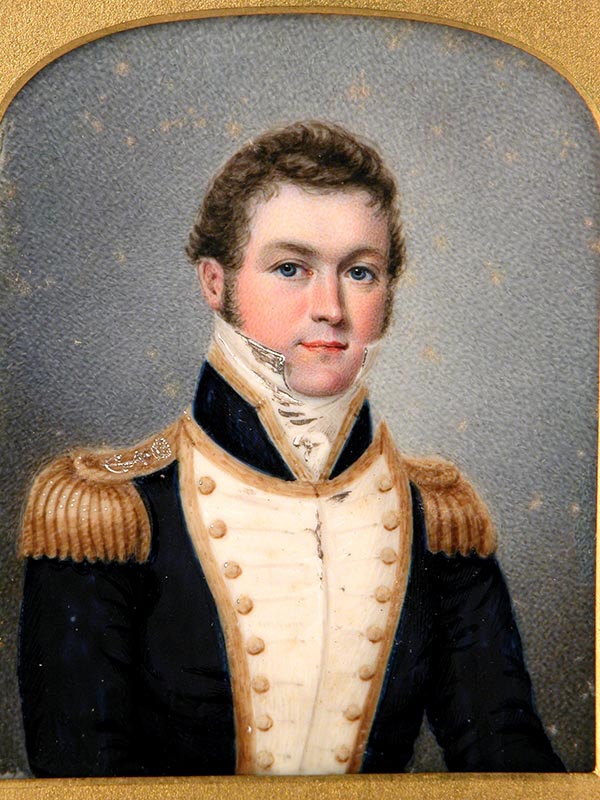
William Stanhope Badcock was born in 1788 and was the second son of Thomas Stanhope Badcock with his wife Anne Buckle. His father had inherited the estates of both Little Missenden Abbey in Buckinghamshire, and Maplethorpe Hall in Lincolnshire, and had served in the 6th Regiment of Foot during the American War of Independence. William entered the Royal Navy in May 1799 at the age of 10, where he was first assigned on board the Royal William, before moving on to the Renown, the flagship of Sir John Borlase Warren, where he remained in service until 1804. After joining several ships in succession, he took up service on the 98 gun Neptune under Captain Thomas Fremantle, a close friend of Lord Nelson. William Stanhope-Badcock was aboard the Neptune during the Battle of Trafalgar on 21October 1805 where the ship was third in Nelson’s division. He continued to progress in the Navy and on 13th August 1812, William was commissioned to his first command, becoming Captain of HMS Brune.
After seeing service in Spain in the Peninsular War, William embarked from Portsmouth in the Spring of 1814, travelling via Bermuda to join the British forces gathered in Chesapeake Bay on the East coast of the United States.
Raids in the Chesapeake
The vast Chesapeake Bay area had already been the target of British attacks in the previous year. From early in the war, the British navy had begun a strategy of blockading ports on the eastern coast of the United States. Beginning with a blockade from Florida to Charleston, South Carolina in 1812, Admiral Sir John Borlase Warren, commander of British naval forces in the North Atlantic and Caribbean, extended his forces to cover the entire eastern seaboard south of New England during 1813. The aim – and effect – was to cripple American overseas trade. Command of the waters of Chesapeake Bay was given to Rear-Admiral Sir George Cockburn, who set about destroying and plundering towns, ships and government supplies along the shorelines in the Spring and Summer of 1813. Chesapeake Bay again became the focus for a renewed offensive in 1814, designed to alleviate pressure and divert resources from the ongoing war on the US-Canadian border. Sir John Borlase Warren’s successor, Vice Admiral Alexander Cochrane had been requested by Sir George Prevost, Governor General of Canada, to pay the Americans back in kind for depredations carried out by their forces in Upper Canada. Since the defeat of Napoleon at the Battle of Leipzig in October 1813, and his subsequent abdication in April 1814, more and more British forces were freed up to reinforce the Navy and military troops in the war effort in North America. Amongst these was Captain William Stanhope-Badcock in HMS Brune.
The Chesapeake Bay Flotilla
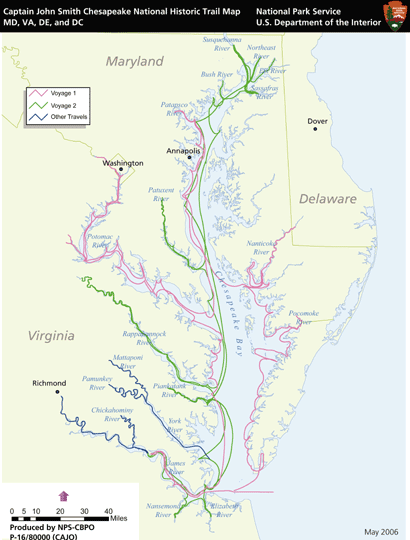
The strategy for defence of the Chesapeake Bay was conceived by American naval officer Joshua Barney, and comprised a motley set of barges and gunboats forming a flotilla. These would harass British boats attempting to land in an attempt to deter raids, but quickly became a target of the British fleet. During June 1814, the flotilla was engaged in various skirmishes with Royal Navy vessels, retreating from the bay into the Patuxent River and then into St Leonard’s Creek. In Badcock’s account, the British pursue the American flotilla up the Patuxent, blockading them in the river. The flotilla, ‘as we advanced, retired up the river to Nottingham, a small town 25 miles above Benedict. We could not follow them with the ships on account of the shoalness [shallowness] of the water.’
Although the flotilla managed to fend off the British attacks, on August 22nd Barney was forced to destroy his own boats to prevent them from falling into British hands. Those manning the flotilla escaped to land and supported the US army in the battles which followed.
Invasion of Washington
The invasion of the nation’s capital was surely the nadir of the 1812 war for the United States. Located on the east bank of the Potomac River, a tributary of the Chesapeake Bay west of the Patuxent, it was an enticingly close target for the British forces wreaking havoc around the bay. It was also inadequately defended; US Secretary of War John Armstrong Jr being convinced that the city would not be subject to a British attack.
Around mid-August, a fleet was gathered in the Chesapeake under command of Vice-Admiral Alexander Cochrane, together with the troops of Major-General Robert Ross, commander of the British land forces on the East Coast of the United States. They were also accompanied by Rear-Admiral Sir George Cockburn, who had led the raids in the Chesapeake Bay in 1813. They again sailed up the Patuxent, landing at the town of Benedict, Maryland on 19-20 August (illustrated in the plan in Add Mss 1376 – see list of sources below).
The British marched on to the town of Upper Marlbro, where they halted for a short time, before General Ross determined to push forward with an attack on the capital. The troops progressed on to Bladensburg where they could cross the eastern branch of the Potomac River and approach Washington D.C. from the northeast. A hastily assembled American force met them in battle at Bladensburg on 24th August 1814, where the British ultimately overwhelmed their enemy.
In the meantime, most people within the city of Washington fled. Dolley Madison, wife of President James Madison, oversaw the removal of cabinet records and valuable treasures from the White House. By the time the British marched into the city at 8.00 in the evening, there was no-one present to parley with or organise a surrender. The British set about burning public buildings including the White House, the Capitol including the Library of Congress, the Treasury and buildings housing the War and State departments. For the most part, however, private property was spared. The fires blazed through the night and the British departed the following day back down towards Benedict.
Primary sources at West Sussex Record Office
Add Mss 1375
These naval papers include an order to Captain Badcock, from Captain Robert Barrie, his senior commanding officer in the Chesapeake.

Add Mss 1376

This is a plan depicting part of the River Patuxent from its entrance on the Chesapeake between Cedar Point and Drum Point up to Upper and Lower Marlboro, and shows Badcock’s vessel, HMS Brune, accompanied by HMS Severn lower down the river. Some of the locations described in Badcock’s account can be seen on the plan, which also depicts the march of the British from Benedict towards Washington ahead of the subsequent invasion.
Add Mss 1380
This collection of miscellaneous naval documents includes correspondence with the Admiralty, and orders issued during the raids on the Chesapeake by both Vice-Admiral Alexander Cochrane and Rear-Admiral Sir George Cockburn.

Add Mss 1382

This collection of naval documents includes Captain William Stanhope Badcock’s account of his own involvement in British operations in the Chesapeake, following his arrival there in July 1814 (view by clicking on the image opposite). He describes joining up with Rear-Admiral Sir George Cockburn at the entrance of the River Patuxent, a tributary of the Chesapeake Bay running into the state of Maryland, and between the major cities of Baltimore and Washington D.C. Over the following weeks, Badcock records participating in blockades, foraging missions for wood, water and other supplies, and raids on towns and settlements.