The Buckle family papers
West Sussex Record Office has many outstanding family archives in its care, but from the perspective of transatlantic (and world) events, the The Buckle Papers (transatlantic-ties.org.uk) are truly worth exploring. With several generations of the Buckle family serving in the Royal Navy, the Buckle papers span the globe, and are an amazing primary source on Britain’s naval activities especially during the 18th and 19th centuries. They are of particular interest for those interested in Britain’s changing role in the Transatlantic Slave Trade since this time period saw Britain move from being enthusiastic participants, leading the charge in transporting enslaved Africans to their colonies in America and the Caribbean, to a position as self-appointed international ‘policemen’ on a mission to suppress the trade.
This page aims to highlight records from the Buckle papers which connect particularly to the transatlantic slave trade as well as draw attention to members of the Buckle family with links to the United States through naval missions, travel and emigration. For a fuller account of the careers and activities of the Buckle family, please refer to the Buckle family biographical information in the catalogue entry here, extracts of which have been adapted for this page).

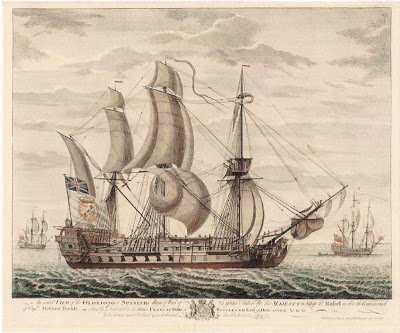
Matthew Buckle (1718-84), was one of the most distinguished naval officers of the 18th century, and was in continuous command of fighting ships for nineteen years from 1744. He entered the navy in 1731 at the age of 13, and was one of five members of the Buckle family ultimately to rise to Flag Rank. His career is unfolded in a series of Log Books which survives for the period 1731-62 (excluding the years 1743-44), and in his Letter and Order Books for 1744-48 (Buckle Mss 96-103, 105-106), as well as a series of miscellaneous papers relating to the naval engagements in which he participated. (Buckle Mss 107-110, 201-213).
With the transatlantic slave trade in full swing during the mid 18th-century, Britain and France clashed over trade (in enslaved people) and settlement on the west coast of Africa, and Captain Buckle commanded several vessels in the protection of British interests.
He undertook a notable commission in 1751-1752 to the coast of modern day Ghana (then known as the Gold Coast) where his purpose was ‘the Protection and Security of the Trade of His Majesty’s Subjects in those parts’. In his orders from the Lords Commissioners of the Admiralty – see Buckle-Mss-108. Captain Buckle is instructed to discover:
‘…whether the Possessions of this Nation, or the Trade of His Majesty’s Subjects in those Parts, have been Incroached on [sic], or Interrupted by the Ships or Subjects of any Other Nation…’
Buckle Mss 460 ‘An Account of the Proceedings on a Voyage to the Coast of Africa by Captain Matthew Buckle, Commander of His Majesty’s Ship Assistance’ is Buckle’s own account of the events of his mission, which takes in gift-giving and negotiations with John Currantee, leader of the Fante, as well as an encounter with the commander of a French ship attempting to encroach on what is considered to be British territory.
His elder and only surviving son, Matthew Buckle (1770-1855), was apprenticed as Captain’s servant with his first cousin Christopher Mason in 1777, but it is not thought that he went to sea until 17 April 1786, when he entered service as Able-Seaman on board HMS Salisbury, a 50 gun ship engaged on the Newfoundland station. Mathew was rated Midshipman in 1787, and for the next six years was chiefly employed on the Newfoundland and West India stations, receiving his first commission as Lieutenant on 21 January 1791. He later commanded the store ship Camel on the North American and West India station from 24 November 1800 to 24 September 1802. See Buckle Mss 139 and 149 in WSRO’s main online catalogue.

Claude Henry Mason Buckle (1803-1894) began his career at Portsmouth Naval College in 1817, and first went to sea as a Volunteer aboard HMS Heron on 30 March 1819. He was promoted to Midshipman on 1 April 1820, and to Mate on 16 February 1825. (Buckle MS. 154). In 1827 he was promoted to Lieutenant and served aboard the Ganges, an 84 gun ship, on the South American station. He afterwards served in the North Sea in the West Indies.
On 7 December 1841 he was appointed to the command of the Growler, a new steam sloop (see Buckle Mss 155) in which he served for nearly four years on the African station employed in the suppression of the slave trade. (see Buckle Mss 6 and Buckle Mss 470)
His surviving papers include an account of an action with a Spanish slaving ship in 1845 (Buckle Mss 156).
Upon his return he was, on 6 November 1845, given a commission as Post-Captain, and four years later, in command of the Centaur, a six-gun steam frigate, he assisted in the recovery of the Grant, a merchant schooner captured by Spanish pirates in Sierra Leone (see Buckle Mss 6, Buckle Mss 158, Buckle Mss 474-476).
Cuthbert Robert Buckle (1837-1901) entered the Royal Navy as a cadet in 1851. He was promoted to the rank of Lieutenant on 19 May 1859, and for the following three years served in the Mediterranean and in the West Indies aboard HMS Aboukir. In November 1867 he was nominated Flag Lieutenant to Rear-Admiral Claude Henry Mason Buckle, and two years later was promoted to Commander. He commissioned H.M. Steam Gun Vessel Cracker in 1873, and served in her on the South American station, principally on the River Plate.
Charles Matthew Buckle (1828-1914) enjoyed a long and distinguished naval career. He developed an interest in the navy at an early age, and in 1838 was sent to Gosport to a preparatory school for boys destined for a naval career. After serving in China, in 1845 Buckle was appointed to the Vernon, the Flagship of Rear-Admiral Samuel Hood Inglefield, Commander-in-Chief on the Brazils and River Plate station. he was later appointed to the Indefatigable, Flagship of Rear-Admiral Sir William James Hope Johnstone, Commander-in-Chief on the Brazil station. Nevertheless, under that officer he was successively appointed Acting Commander of the Harrier, steam sloop of 17 guns, of the Siren, 16 gun brig, and of the Indefatigable itself (Buckle Mss 194). In 1861 the American Civil War was at its height, and the affair of the Trent enhanced the prospect of war between England and the States. Four transatlantic steamers were requisitioned to transport troops to the St. Laurence to protect the Canadian colonies, and, on the promise of a command on returning to England, Buckle was persuaded to join the Adriatic. For a period of twelve weeks in the winter of 1861-62 the ship was frozen in the Gulf of Sydney, Cape Breton. (Buckle Mss 6, Buckle Mss 7, Buckle Mss 194, Buckle Mss 269).
Buckle was a keen traveller and prolific writer, who kept detailed journals for many years. In 1885 he embarked on a three-month tour of the United States – read more here: Travels in America. His nephew Cuthbert Edward Buckle emigrated to the United States and corresponded regularly with his family back home – see Letters from Emigrants.